Case Study 02
Engineering Custom Full-Stack Platforms for Competitive Tabletop Gaming
Two self-built web apps that became fixtures of a global strategy-gaming scene.
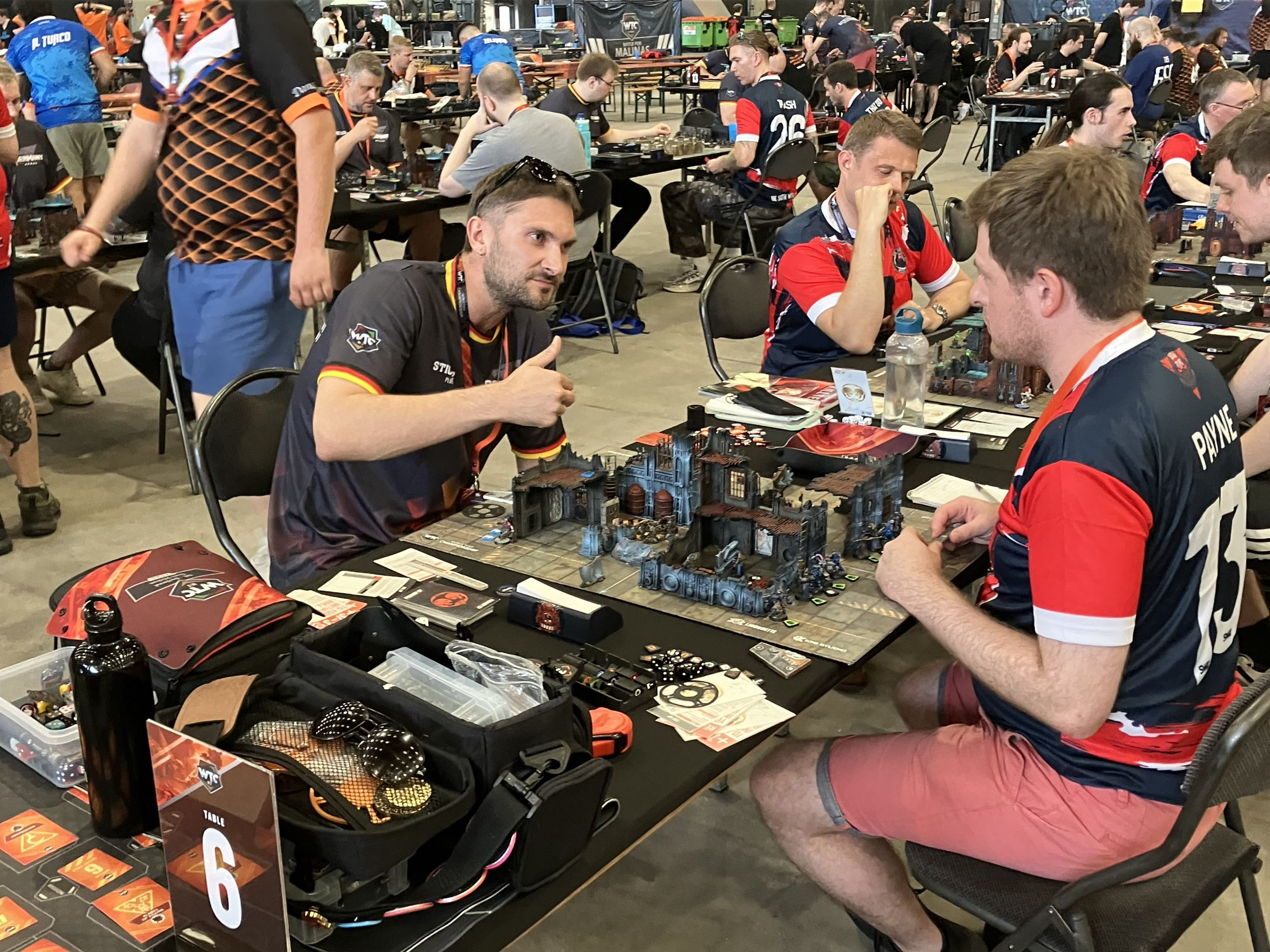
As an active tournament player and member of the German world-championship team, I combined my passion for complex game systems with modern software engineering — conceiving, designing, and building two independent, data-intensive web applications entirely in my spare time.
- Role
- Product Designer, Full-Stack Developer & Community Builder (Pro-Bono / Personal Project)
- Products
- KT-Openplay — Open-Access Game Tracker · KTLeague — Division League Operations Platform
- Tech Stack
- v0 / Vercel, Supabase (Database, Auth, Row-Level Security), Tailwind CSS, Claude Code/Design
- Funding & Drive
- Spare-time project — 100% community-funded via Ko-fi, built in close feedback exchange
Both platforms are free to use and 100% community-funded.
Community impact at a glance
Executive summary & passion-project context
As an active tournament player and member of the German world-championship team in tabletop strategy sport, I connect my passion for complex game systems with modern software development. To deliver real value to the global and national community, I conceived, designed, and built two standalone, data-intensive web applications in my free time.
The project follows a dual approach: an open-source, fast tracking tool for casual play (KT-Openplay) and a closed, rule-based platform for the national league operation in Germany (KTLeague).
What is competitive tabletop gaming?
Competitive Tabletop Gaming is a head-to-head strategy format where two players control miniature figures or tactical units on a 3D, terrain-filled battlefield to complete mission objectives.
- Objective-based play
- Victory relies on scoring strategic goals, capturing key points, or outmaneuvering opponents, rather than simply eliminating all enemy forces.
- Turn-based strategy
- Players alternate actions, requiring deep spatial awareness, risk assessment, and adaptability under time pressure.
- Standardized rulesets
- Official tournament formats ensure fair, balanced competition using specific time limits, terrain layouts, and scoring systems.
Think of it as a physical, three-dimensional version of competitive chess mixed with modern real-time strategy video games — offering a highly structured environment for tactical problem-solving and analytical thinking.
The two products
Product 01
KT-Openplay
Zero-friction match tracking
 01 / 06
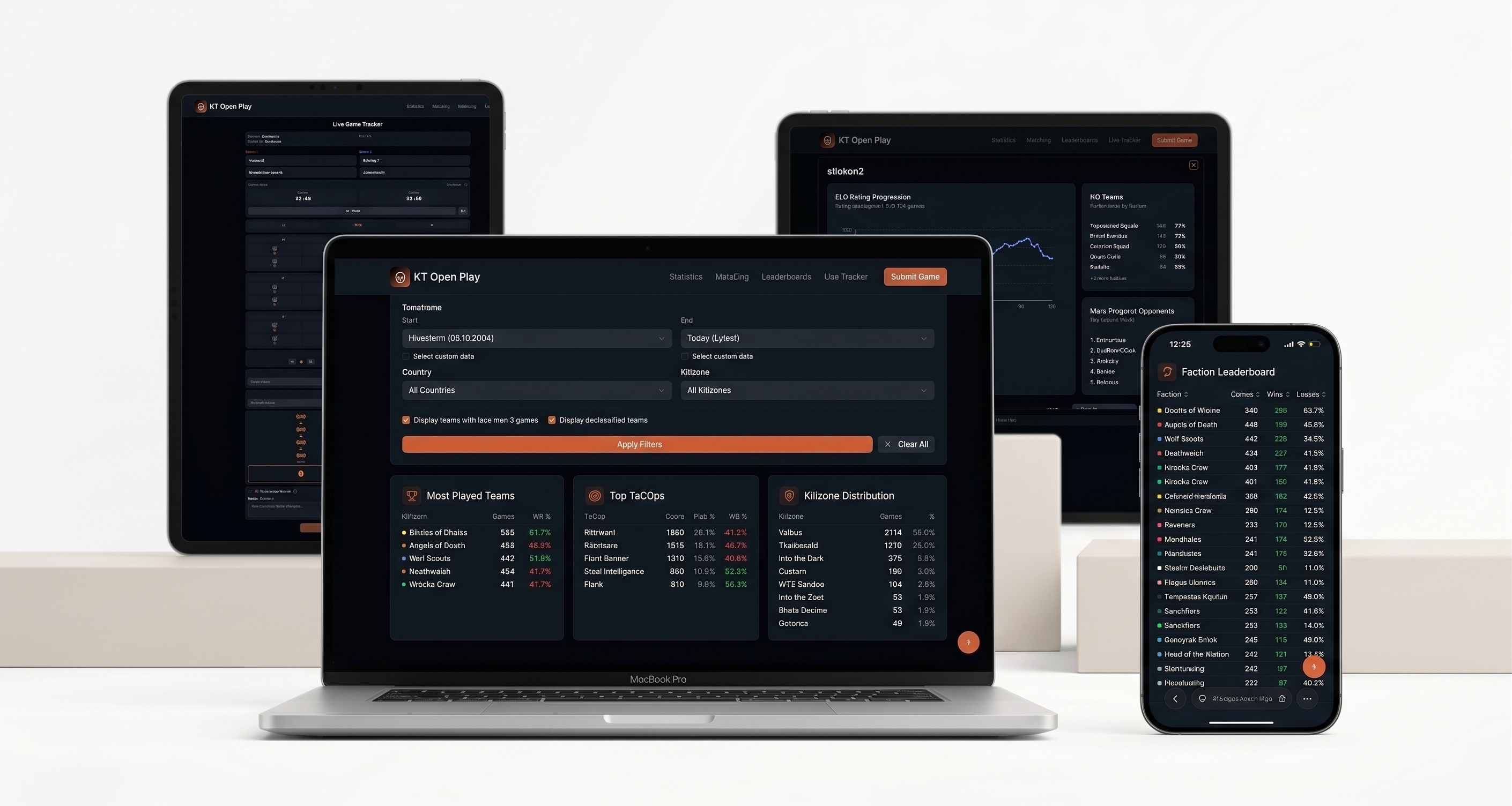
KT-Openplay is an open-access, zero-friction game-tracking platform engineered for the global competitive tabletop gaming community. It lets players log detailed match data instantly at the gaming table without any registration or sign-up. The application automatically aggregates match histories, calculates dynamic player Elo ratings, and generates holistic meta-statistics for data-driven insight into faction balance and global competitive trends. Powered by Next.js, Vercel, and Supabase, it blends rapid performance with complex database logic.
The UX challenge
Players reject mandatory logins and registration during on-site games at the table, because they interrupt the flow of play.
The solution (zero-friction identity)
Full usage without registration or password. On first entry, Supabase stores the game and automatically assigns it via name- and ID-matching logic. This enables lightning-fast match-data entry at the table, while complex Elo calculations and global meta statistics are generated in the background.
Highlights
- No-login match capture with automatic player attribution
- Background Elo calculation & global meta statistics
- Open access for the casual play community
Product 02
KTLeague
Organized division league
 01 / 04
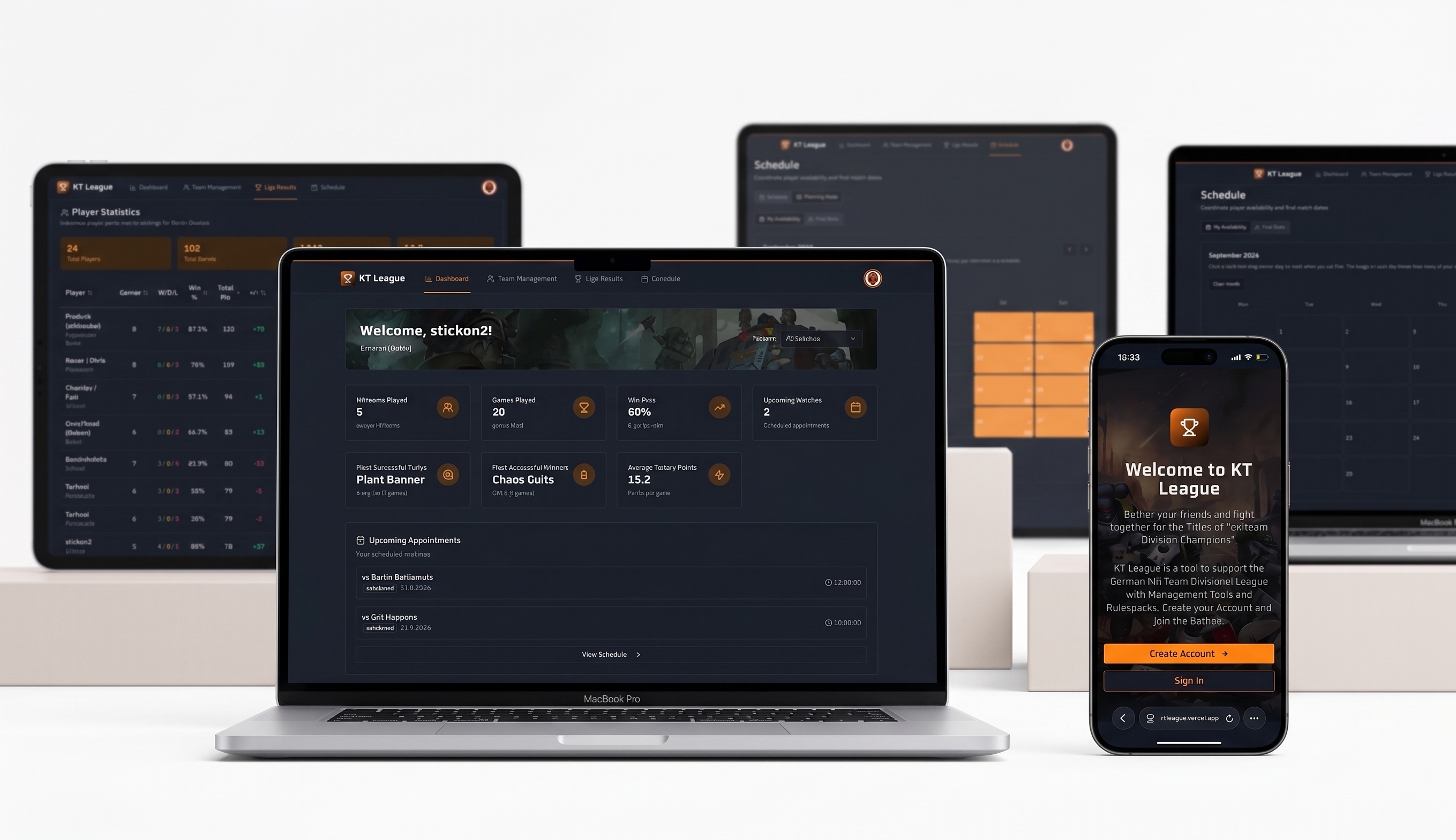
KTLeague is the operations backbone of the German Kill Team Divisional League. It gives regional divisions of 3+ player teams everything they need in one place: team management, availability-based scheduling across a flexible six-month season, verified match reports, live division tables, and player analytics — all governed by a shared, transparent rulepack.
The UX challenge
Coordinating a biannual national-league season across all of Germany requires binding scheduling, match verification, and protected results.
The solution
A closed platform with Supabase authentication. Core features include automated availability matching for scheduling, table & division calculators, match reports with photos and list setups, and member profiles.
Core features
- Automated availability matching for fixtures
- Table & division calculators
- Match reports with photos and list setups
- Authenticated member profiles
AI-driven product engineering
The programming-language barrier
The entire ecosystem uses a unified, state-of-the-art stack of v0, Vercel, and Supabase. Through the targeted use of AI code generators (v0 / Claude), I was able to write complex logic, database schemas, and frontend state in record time — without the classic coding hurdles.
Consistency, cost & the maker philosophy
AI-assisted layout generation guarantees a clean, consistent UI system across both applications with minimal maintenance effort. What would once have required a multi-person developer team over months was brought to market readiness as a maker project in a few weeks — living proof of my method: from user-needs analysis in the community, through AI-assisted rapid engineering, to years of live scaling with real users.
“Fail ultra fast, succeed even faster.”